Chargebacks are the single biggest threat to online merchants in 2026. Every year, businesses around the world lose billions of dollars to fraudulent disputes, friendly fraud, and bank-initiated reversals. For high-risk merchants—those operating in industries like online gambling, adult content, IPTV, Forex trading, CBD, and digital goods—the problem is exponentially worse.
The question is no longer "How do I reduce chargebacks?" It is: "Is there a payment gateway that eliminates chargebacks entirely?" The answer is yes. A card-to-crypto payment gateway like Chain2Pay fundamentally removes the chargeback mechanism from the equation.
1. Introduction: The Chargeback Problem
Traditional payment gateways like Stripe, PayPal, and Square were not designed for high-risk commerce. They operate under strict banking regulations that give consumers the upper hand in every dispute. A single spike in your chargeback ratio can result in your merchant account being terminated, your funds frozen for months, and your business being placed on the MATCH list—a global blacklist that prevents you from accepting card payments with any processor.
In this comprehensive guide, we will explain exactly how a chargeback-free gateway works, why it is the best solution for high-risk businesses, and how you can start using it in minutes—with no signup, no KYC, and no forced account creation.
2. What Is a Chargeback-Free Payment Gateway?
A chargeback-free payment gateway is a payment processing solution where the merchant settlement happens outside the traditional banking system, making it impossible for a bank to reverse the transaction after the funds have been delivered.
In a conventional payment flow, Visa or Mastercard sits between the customer and the merchant. If the customer disputes the charge, the card network can initiate a chargeback—pulling the money directly out of the merchant's bank account, often with an additional $15–$100 penalty fee on top.
With a no chargeback payment gateway, the flow is different:
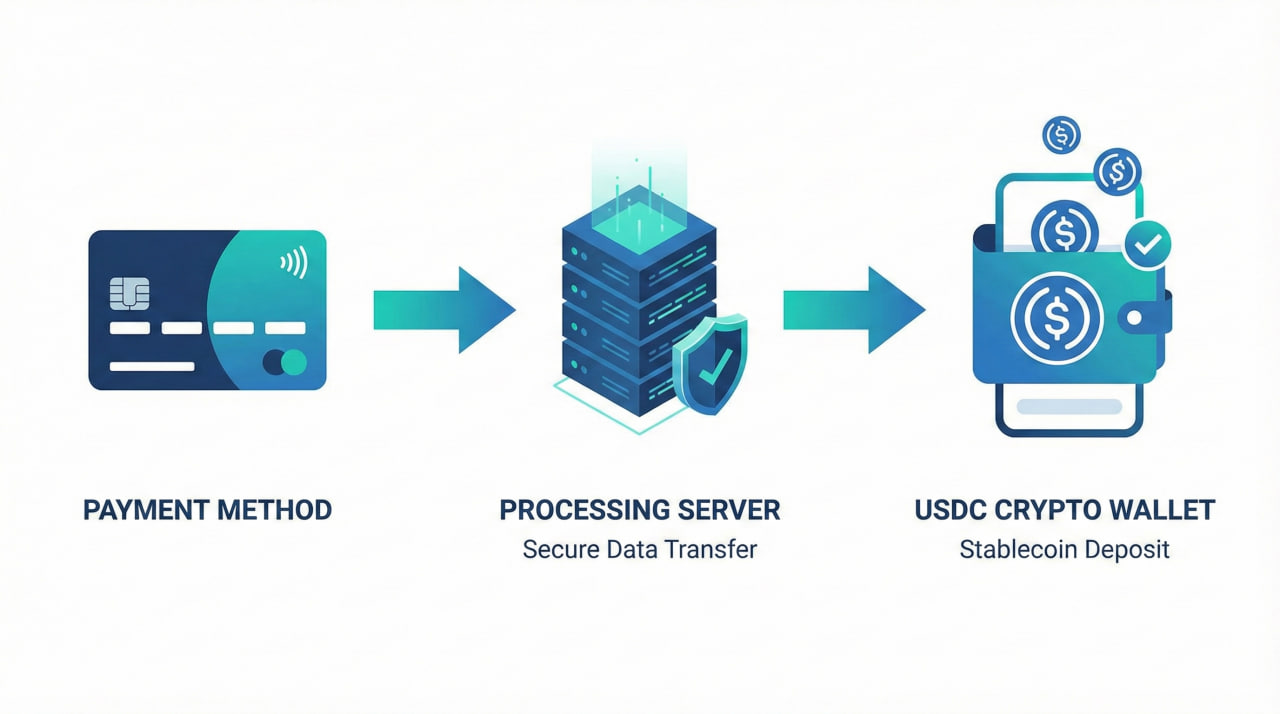
- The customer pays with their credit or debit card (Visa, Mastercard, Apple Pay, Google Pay).
- The payment is processed through a specialized high-risk acquiring network.
- The merchant receives settlement in cryptocurrency (USDC on Polygon), sent directly to their personal non-custodial wallet.
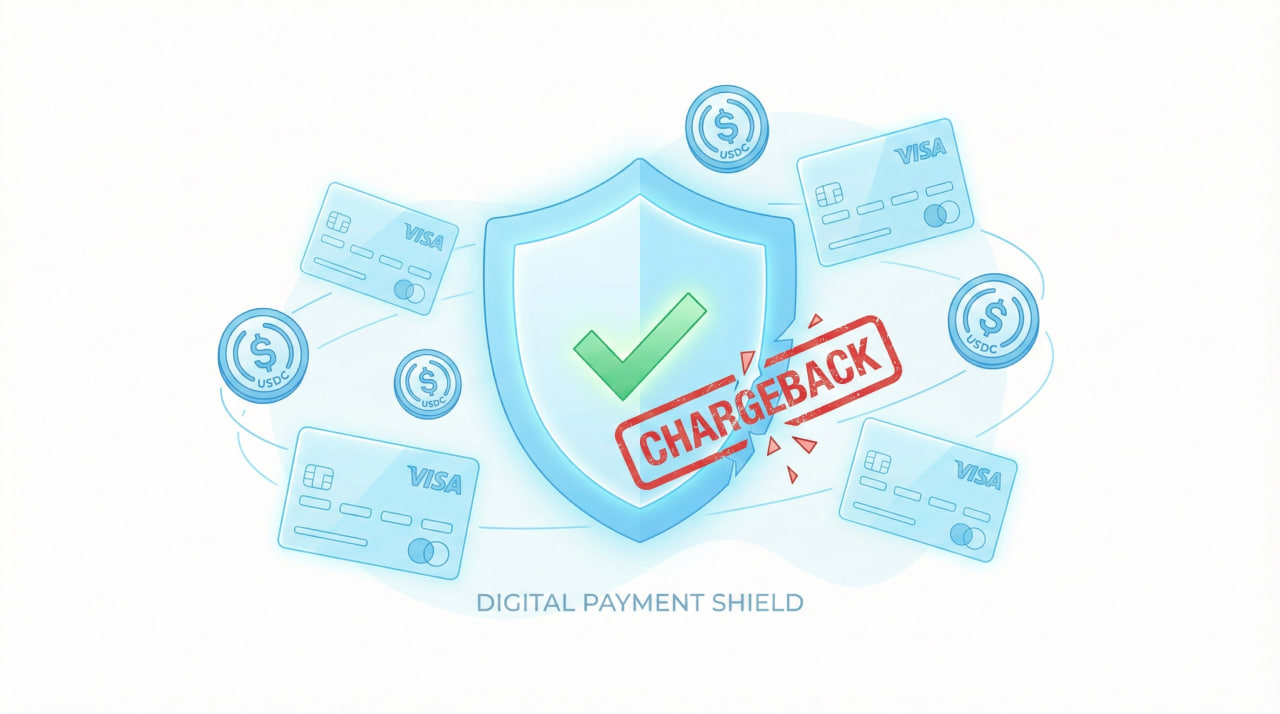
Key Insight: Chargebacks are a feature of the banking system, not the payment itself. By settling outside the banking system (in crypto), the chargeback mechanism simply does not apply to the merchant.
3. How Card-to-Crypto Payments Eliminate Chargebacks
The card-to-crypto payment gateway model is the technological breakthrough that makes chargeback elimination possible. Let us walk through the entire process step by step.
Step 1: Customer Checkout
Your customer visits your website, selects a product, and proceeds to checkout. They enter their Visa or Mastercard details into a standard, 3D Secure-enabled payment form. The experience is identical to any mainstream e-commerce checkout.
Step 2: Fiat Processing
The card payment is routed through Chain2Pay's network of crypto-friendly acquiring banks. These banks specialize in processing high-risk transactions and are fully authorized to handle card payments for industries that traditional banks reject.
Step 3: Instant Conversion & Settlement
Once the card payment is approved, the fiat amount is instantly converted to USDC (a stablecoin pegged 1:1 to the US Dollar) and sent to the merchant's wallet on the Polygon network. There is no holding period.
Step 4: Finality
Once the USDC is in your wallet, the transaction is final and irreversible. Even if the customer later files a dispute with their bank, the chargeback liability stays with the acquiring network—not with you.
4. Why Chain2Pay Is the Best No-Chargeback Gateway
There are several card-to-crypto gateways on the market, but Chain2Pay stands out for multiple reasons.
No Signup, No KYC, No Forced Login
Most payment gateways require you to submit business documents, passports, bank statements, and wait days or weeks for approval. Chain2Pay requires none of that. You simply provide your USDC (Polygon) wallet address, generate a payment link or install a plugin, and start accepting payments immediately.
Instant USDC Payouts
When a customer pays, the USDC arrives in your wallet within minutes—not days or weeks. There are no payout schedules, no "minimum payout thresholds," and no manual withdrawal requests.
Zero Rolling Reserves
Traditional high-risk processors hold 10–25% of your revenue in a "rolling reserve" for 90 to 180 days. Chain2Pay has zero reserves. Every dollar you earn is available to you instantly.
No Frozen Funds
Chain2Pay settles to your personal, non-custodial wallet. We never hold your funds. We cannot freeze what we do not control.
5. High-Risk Industries That Benefit Most
The no chargeback payment gateway model is especially valuable for industries that are classified as "high-risk" by traditional banks:
- Online Casinos & iGaming: Players who lose money often file chargebacks claiming "unauthorized transactions."
- Adult Content & Entertainment: "Shame chargebacks" are rampant in the adult industry.
- IPTV & Streaming Services: IPTV resellers face some of the highest chargeback rates in e-commerce.
- Forex Brokers & Trading Platforms: Traders who make losing investments often try to reverse their deposit.
- CBD & Cannabis: Despite legalization, CBD businesses are still classified as high-risk by banks.
- Digital Keys, Software Licenses & SaaS: Digital goods carry inherent chargeback risk.
6. Chain2Pay vs. Stripe: Why Merchants Are Switching
Stripe is the world's most popular payment gateway—but it is also the most feared by high-risk merchants. Stripe's automated risk engine can freeze your account, hold your funds for 90+ days, and permanently ban your business with a single automated decision—often with no human review and no appeal process.
Key Differences
- High-Risk Support: Stripe bans high-risk industries on sight. Chain2Pay supports them by design.
- Chargebacks: Stripe puts full merchant liability on you. Chain2Pay settles in crypto, so no chargebacks can reach your funds.
- Settlement Time: Stripe takes 2–7 business days. Chain2Pay is instant.
- Rolling Reserves: Stripe can reserve 10–25% for 180 days. Chain2Pay holds zero.
- KYC / Onboarding: Stripe requires full verification. Chain2Pay requires none.
7. Instant Settlement & No Frozen Funds
One of the most devastating aspects of traditional payment processing is the settlement delay. With Stripe, you wait 2–7 business days to receive your money. With high-risk acquirers, you might wait 30 days—or longer if your account is under review.
Chain2Pay offers true instant settlement. The moment a customer's card payment is approved, the equivalent USDC amount is sent to your Polygon wallet. You can verify the transaction on PolygonScan in real-time.
No Frozen Funds, Ever. Because your settlement goes directly to your personal, non-custodial wallet (MetaMask, Trust Wallet, Ledger, or any EVM-compatible wallet), there is no intermediary that can freeze, hold, or seize your funds. You are your own bank.
8. WooCommerce, WHMCS Plugins & API Integration
Chain2Pay is not just for tech-savvy developers. We offer multiple integration methods to fit any business, from a single freelancer to a large e-commerce platform.
WooCommerce Plugin (WordPress)
If you run a WordPress/WooCommerce store, our official plugin integrates in minutes. Simply install the plugin, enter your USDC wallet address, and your store will automatically generate payment links for every order.
WHMCS Plugin (Web Hosting)
For web hosting companies and domain registrars using WHMCS, our dedicated plugin automates payment collection and order fulfillment.
Developer API
For custom integrations, our RESTful API gives you full control. Generate payments programmatically, set callback URLs for webhook notifications, and track transaction statuses in real time.
const response = await axios.post('https://chain2pay.cloud/api/v2/payments', {
  amount: "49.99",
  currency: "USD",
  merchant_wallet: "0xYourPolygonWallet",
  customer_email: "buyer@example.com",
  provider: "multihosted",
  callback_url: "https://yoursite.com/payment-callback"
}, { headers: { 'x-api-key': 'sk_live_...' } });
// Redirect user to response.data.payment_url
The API returns a payment_url that you redirect the customer to. Once they pay, your callback_url receives a webhook with the transaction details (TXID, amount, coin, and order ID).
9. Frequently Asked Questions
Is Chain2Pay really chargeback-free?
Yes. Because settlement happens in USDC on the Polygon blockchain, the funds in your wallet cannot be reversed by any bank or card network. The chargeback liability stays with the acquiring network, not with you as the merchant.
Does the customer need to own cryptocurrency?
No. The customer pays with their regular credit or debit card (Visa, Mastercard, Apple Pay, Google Pay). They do not interact with crypto at all. The conversion happens behind the scenes, and the merchant receives USDC.
Do I need to create an account or verify my identity?
No. Chain2Pay does not require registration, email verification, or KYC documents. You simply provide your USDC (Polygon) wallet address and start generating payment links or installing plugins immediately.
Is this a good Stripe alternative for high-risk businesses?
Absolutely. Chain2Pay is designed specifically for merchants that Stripe, PayPal, and Square reject. There is no risk of account termination, fund freezes, or chargeback penalties.
10. Conclusion
In 2026, there is no reason for any merchant—especially those in high-risk industries—to continue losing money to chargebacks, frozen funds, and rolling reserves. The card-to-crypto payment gateway model has matured into a reliable, instant, and secure alternative to traditional banking.
Chain2Pay is the leading payment gateway without chargebacks, offering instant USDC settlement, zero KYC requirements, no forced logins, and seamless integrations through plugins and API.
Stop giving banks the power to freeze your income. Start accepting payments on your own terms.